Welcome to our Water Treatment Company!
We'are Open: Mon - Sat 10:00 AM - 06:00 PM

- Call Us for help!
- +91-9911981992
- Mail Us
- sales@innovacorporate.com
Manufacturers, Exporters and Suppliers of INNOVA SP 415 – Cationic Colour Precipitant Coagulant for Wastewater Treatment in Agra
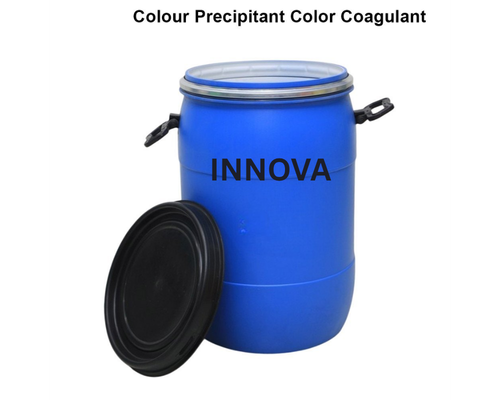
Coagulant Cationic Colour Percipitant (INNOVA SP 415) in Agra
Innova Corporate's Coagulant Cationic Colour Percipitant is a high-charge-density cationic polymer specifically formulated for Agra's textile dyeing and printing effluent. The textile industry in Agra (mainly small-scale dyeing units) discharges highly colored wastewater containing reactive dyes, direct dyes, and dispersed pigments that are difficult to remove by conventional sedimentation. Our coagulant works by neutralizing the negative surface charge of dye molecules, causing rapid flocculation and precipitation. The product is based on polyDADMAC (poly diallyl dimethyl ammonium chloride) with a molecular weight of 200,000-500,000 Da and charge density >5 meq/g. For Agra's common effluent treatment plant (CETP) receiving mixed textile and tannery waste, this coagulant reduces color by up to 95% at dosages of 50-150 ppm. It also precipitates disperse dyes that escape biological treatment. The product works optimally at pH 6-9 and is compatible with anionic flocculants (used downstream). Field data from Agra's textile cluster showed that using this coagulant before an ultrafiltration (UF) membrane reduced fouling by 60%. For direct discharge into Yamuna (not allowed, but some still do), color removal is critical to meet CPCB norms of 200 Hazen units. Our product also removes some COD (20-30%) and turbidity. Available as a 20-40% active liquid. Dosing via magnetic flow meter controlled pumps recommended. For Agra's tanneries, it helps precipitate chrome-complex dyes used in leather finishing. Pack sizes: 30kg carboy, 200kg drum, 1000kg IBC.
Features :
High percentage of decolourising can be obtained.
Because of its cationic nature, it helps in the Dorr clarifier by where an Ionic flocculant is used for floc formation.
Simple to use
No capital cost involved.
Dosage & Feeding :
The percentage decolourisation obtained depends upon the INNOVA SP 415 quantity used, upto certain limits. Under normal conditions, 10 to 20 ppm, on juice is sufficient to achieve a high degree of decolourisation. The dosing point should be into the sulphited juice entering the Dorr Clarifier or in the mixed juice tank.
It is desirable that some contact time to be permitted so that the colouring matters and other impurities get a chance of attaching themselves to the INNOVA SP 415 molecules. Higher dilution is necessary because of the concentrated nature of INNOVA SP 415; dilution at a level of 1:20, with water, is recommended prior to its being dosed.
Dosing pumps should be used for dosing the diluted product to ensure thorough and proportionate mixing. Product dilution and feeding should be done from plastic barrels only.
Storage & Handling :
INNOVA SP 415 has a long shelf life it should be stored at ambient temperature. Avoid contact with eyes, skin and food. In case of contact, immediately flush eyes or skin with large amount of water several times.